CMI researchers at Arizona State University conducted the research for this highlight
Innovation
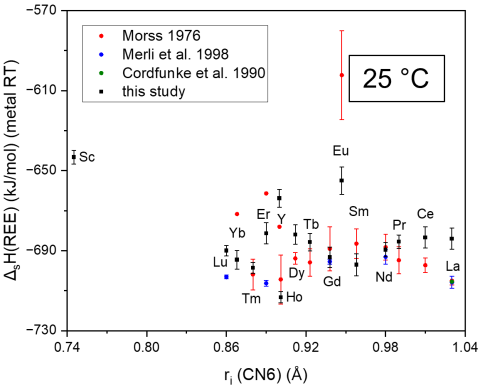
The team measured the enthalpies of dissolution of REE metals and their common oxides, determining the enthalpies of dissolution in solvents in which dissolution is inhibited by kinetics or oxidation, thus providing updated values of thermodynamic properties for incorporation in next-generation models.
Achievement
Enthalpies of dissolution of the REE metals and oxides have been determined using our room temperature acid calorimeter and high temperature drop solution calorimeter (ThermotU, ASU). Results submitted to J. of Physical and Chemical Reference Data.
Significance and Impact
- REE demand is increasing and changes in global trade mean that new sources and better models are needed to optimize recovery and strengthen U.S. supply chains.
- Scientific exploration, industrial applications, and geochemical models need precise data for REE metals and oxides to understand the thermodynamics of other REE containing materials.
- To address these requirements, we measured enthalpies of dissolution of metals in acid (5 N HCl at 25 °C) and oxides in molten salt (sodium molybdate at 800 °C).
- These data were used to calculate the dissolution behavior of the metals at high temperature, and the oxides at room temperature.
Hub Target Addressed
Developing and applying scientific tools to accelerate technology maturation.