CMI researchers at Lawrence Livermore National Laboratory conducted the research for this highlight
Innovation
Identified solution conditions that maximize intra-REE selectivity of lanmodulin.
Achievement
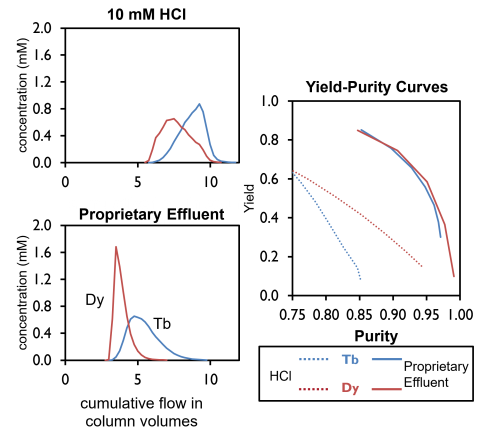
Developed a desorption scheme that enables adjacent HREE separation. Achieved 95% purity at yields above 56% for TbIII and DyIII in a single column cycle. The prior HCl elution achieved only 77% purity at similar yields.
Significance and Impact
- LanM can facilitate adjacent HREE separations that are difficult to achieve using conventional SX ligands
- Next Steps: Extend new separation methodology to more selective protein variants.
Hub Target Addressed
Developing highly selective separation from complex sources.