CMI Highlight: Development of a multicomponent thermodynamic database for molten salt processing of rare earths
CMI researchers at Lawrence Livermore National Laboratory conducted the research for this highlight.
Innovation
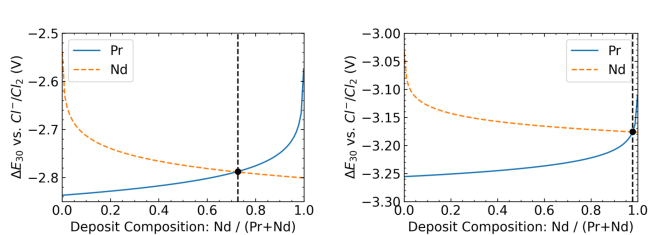
New model to optimize salt composition and operating temperature to maximize the La, Ce, Pr and Nd electrowinning efficiency in CaCl2, KCl and LiCl containing salts
Achievement
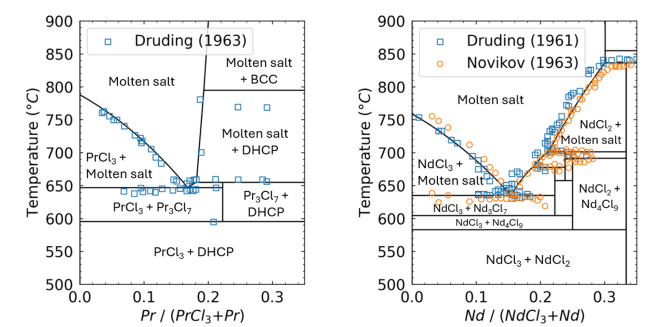
Developed a new open thermodynamic database (published in Calphad journal) to predict molten salt solubility and speciation in the (Ca-K-Li)-(La-Ce-Nd-Pr)-Cl composition space
Significance and Impact
- Reduced cost and time to optimize new processing conditions (large design space) for production of RE metal via molten salt electrolysis (for project 2.2.8)
- New model suggests that the molten salt composition can be tuned to bias RE deposition during the electrowinning process, potentially leading to an alternative separation technique
Hub Target Addressed
Developing and applying scientific tools to accelerate technology maturation
https://doi.org/10.1016/j.calphad.2026.103003