
Development of a multicomponent thermodynamic database for molten salt processing of rare earths

CMI researchers at Lawrence Livermore National Laboratory conducted the research for this highlight

Innovation 
New model to optimize salt composition and operating temperature to maximize the neodymium (Nd) and praseodymium (Pr) electrowinning efficiency.

Achievement
Developed a new thermodynamic database and models to predict Nd and Pr solubility and speciation in molten chlorides.

Significance and Impact

  • Reduced cost and time to optimize new processing conditions (large design space) for production of RE metal via molten salt electrolysis (for project 2.2.8)
  • New model can be used to investigate if a molten salt composition can be tuned to promote separation of RE (by maximizing the difference between EMF potentials) during the electrowinning process. 

Hub Target Addressed
Developing and applying scientific tools to accelerate technology maturation.
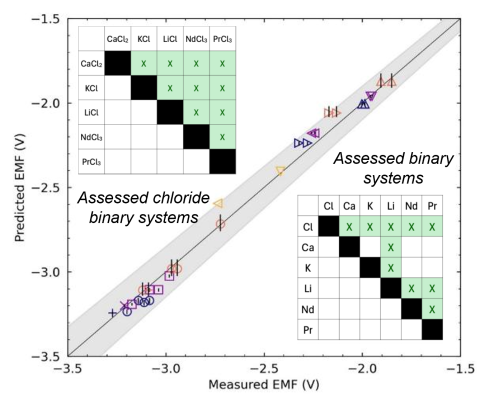
 

Comparison between predicted and measured EMF of 𝑁𝑑+3+3𝑒−→𝑁𝑑0, 𝑁𝑑+3+𝑒−→𝑁𝑑+2 and 𝑁𝑑+2+2𝑒−→𝑁𝑑0 reactions in various KCl-LiCl-NdCl3 mixtures and temperatures. The shaded area corresponds to a maximum deviation of +/- 5% (10% total) compared to the exact Measured/Predicted matching values (black sloid line), highlighting that all predictions fall well below 15% of experimental values and validating our contribution to the CMI FA4 Year 13 goal.