CMI Highlight: Computational framework for bio-based REE selectivity
CMI researchers at Iowa State University conducted the research for this highlight.
Innovation
Developed a transferable computational framework, initially devised to elucidate LanM–REE binding, that can be extended to rationalize REE selectivity in other materials.
Achievement
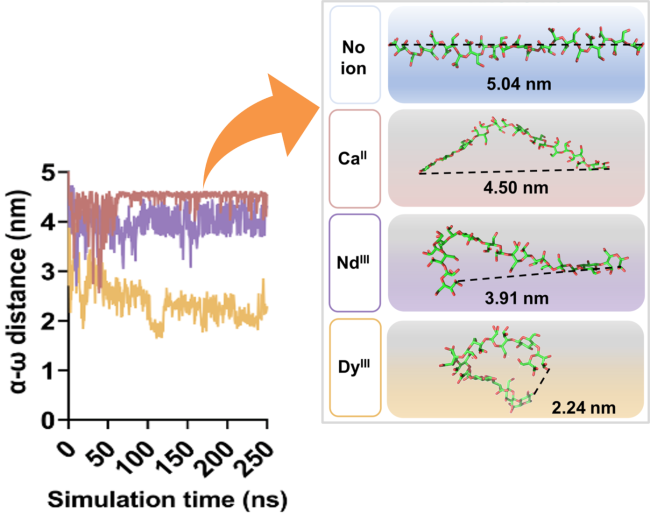
Showed that the computational framework can be used to design novel synthetic materials exhibiting enhanced selectivity for specific REE, by making use of insights related to hydrogen bonding, thermal fluctuations, and ion binding in biological materials.
Significance and Impact
- A nanocellulose material with surface features suggested by the model was fabricated with separate funding (non-CMI) and demonstrated highly selective Dy uptake.
- Leveraging biological design rules enables rapid development of highly selective novel materials for complex separations.
Hub Target Addressed
Developing highly selective separation from complex sources.