
CMI Highlight: Achieving uniaxial magnetic anisotropy in Ce2Fe17N3
CMI researchers at Oak Ridge National Laboratory conducted the research for this highlight.
Innovation
CMI teams led experiments and first-principles calculations to engineer uniaxial magnetic anisotropy in Ce2Fe17N3 through Co- or partial Sm-substitution.
Achievement
Substituting 20–30% of Fe with Co induced uniaxial anisotropy in Ce2Fe17N3 while retaining a saturation magnetization of ~1.44 T. Partial substitution of Ce with Sm yielded anisotropy fields up to 8 T, Curie temperatures of 724–749 K, and decomposition temperatures near 973 K.
Significance and Impact
This combined experimental and theoretical effort establishes design pathways for Ce-Fe based magnets with strong intrinsic magnetic properties and improved thermal stability, supporting their potential as high-performance permanent magnets.
Hub Target Addressed
Accelerated magnet discovery and maturation.
N. Pokhrel, A. Raja , B. C. Sales, G. D. Samolyuk , D. Schlagel, O. Palasyuk, A. Palasyuk , and D. S. Parker, Phys. Rev. Mater. 10, 084405 (2026).
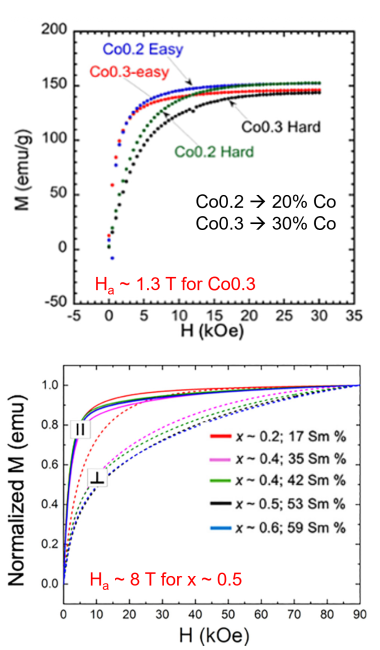
(Ce1-xSmx)2Fe17 samples (bottom)