CMI researchers at Ames National Laboratory conducted the research for this highlight
Innovation
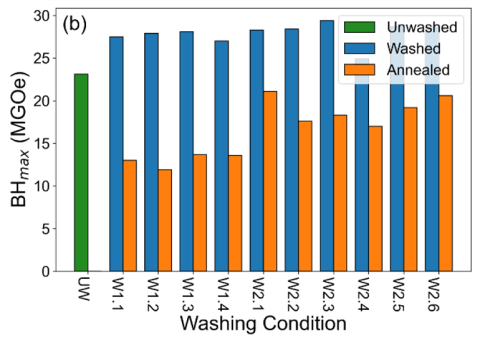
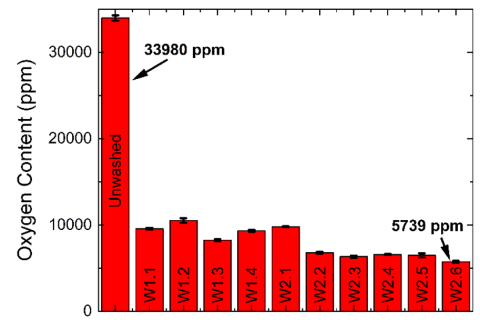
Washing Sm2Fe17N3 with non-aqueous solvents to remove CaO reduces oxygen content and better preserves coercivity and BHmax after annealing.
Achievement
Optimized the process of removing the CaO byproduct from Sm2Fe17N3 powders produced by the reduction-diffusion (RD) approach, reducing the oxygen content and thus preserving its magnetic properties.
Significance and Impact
- Criticality and cost: this material is mostly Fe (~74% wt.%) and non-critical rare earth Sm, as well as earth-abundant N. The RD method allows for direct synthesis from rare earth oxides, bypassing metallization.
- When fully developed, single grain-single particle Sm2Fe17N3-based materials are expected to replace heavy rare earth Nd-based magnets in high performance, high temperature applications.
Hub Goal Addressed
Reducing critical rare-earth content in permanent magnets.