
 Scientific Achievement
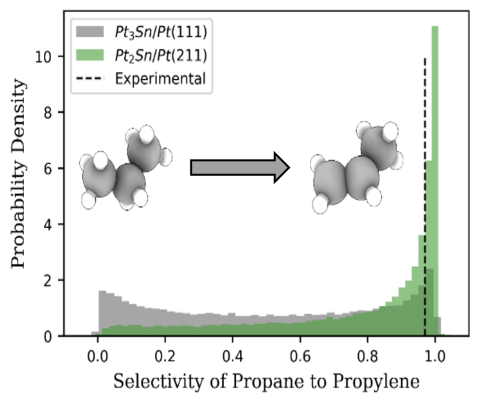
Addition of Sn to Pt-based catalysts reduces coke production during propane processing. Sn addition also leads to a reduced activity across all surface facets of a catalyst particle; however, specific modification is surface facet dependent. Selectivity of dehydrogenation versus hydrogenolysis of a surface facet is possibly not impacted by Sn. However, catalyst particle selectivity is impacted by reduction in activity of a surface facet that is selective towards a specific reaction. Stepped surfaces appear to display the highest selectivity towards dehydrogenation, while the (100) facet can catalyze various reactions.
Significance and Impact
Pt-based catalysts are used for alkane and polyolefin processing. Identifying the active site and understanding the role each active site on the catalyst is essential for designing better catalysts.
Research Details
- DFT calculations for propane and all of its dehydrogenation and hydrogenolysis products on Pt(111), Pt(100), Pt(211) and Sn modified (111), (100), and (211) surface facets.
- Microkinetic model development that considers correlation structure of uncertainties in DFT energies
Integration of experimental kinetic data into computational models for Bayesian model selection
Fricke et al. ACS Catal. 2023, https://doi.org/10.1021/acscatal.3c00939
iCOUP, an EFRC Supported by Basic Energy Sciences
Work was performed at USC and UNCC.