
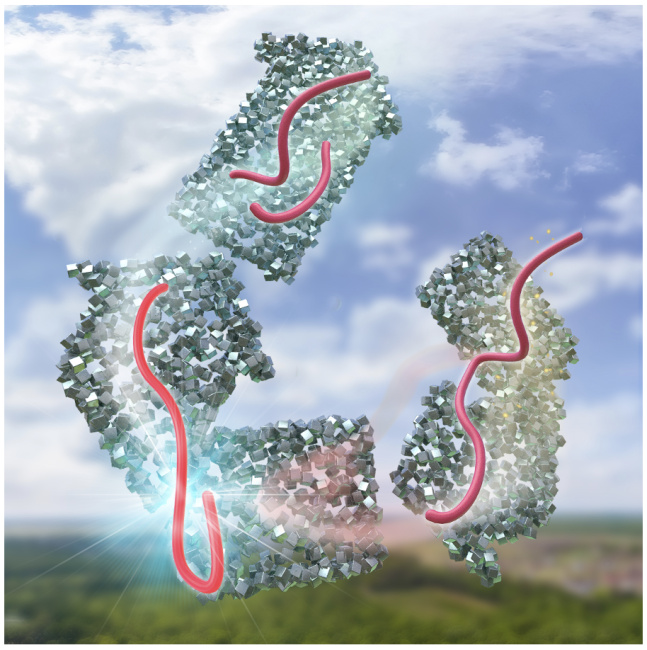
Scientific Achievement
Single-use plastics are generated at alarming rates, and our current economic system offers limited opportunities to recycle them. Most plastics end up in landfills, and state-of-the-art recycling methods (mechanical recycling and pyrolysis) are not yet able to convert polyolefin materials into value-added products, as would be needed to meaningfully address the plastic waste pollution problem. Catalytic hydrogenolysis is a promising technique for converting polyolefin materials into products with potential commercial use.
Significance and Impact
Pt nanoparticles on SrTiO3 nanocuboid supports (Pt/STO) has been shown to selectively convert a variety of polyolefin feedstocks into liquid products with properties that make them commercially viable as automotive lubricants. Deposition methods and synthesis techniques such as microwave-assisted hydrothermal heating have been developed to scale the output of Pt/STO catalyst syntheses beyond the benchtop
Research Details
- Future development of industrially viable synthesis methods, such as flow-based systems, to realize Pt/STO production at the pilot scale.
- Synthesis of new hydrogenolysis catalysts should be pursued by targeting properties that have made Pt/STO a successful catalyst, such as epitaxial match between the catalyst and support.
- Investigations of the mechanism of polyolefin hydrogenolysis by particle-based molecular dynamics simulations should be performed.
Peczak, I. L., et al. “Treasuring trash: Pt/SrTiO3 catalysts process plastic waste into high-value materials” Matter 2023, 6, 3296-3321. https://doi.org/10.1016/j.matt.2023.06.038
Supported by the Institute for Cooperative Upcycling of Plastics (iCOUP), an Energy Frontier Research Center funded by the U.S. Department of Energy, Office of Science, Basic Energy Sciences under contracts DE-AC-02-06CH11357 and DE-AC-02-07CH11358.
Work was performed at Argonne and Northwestern