
Scientific Achievement
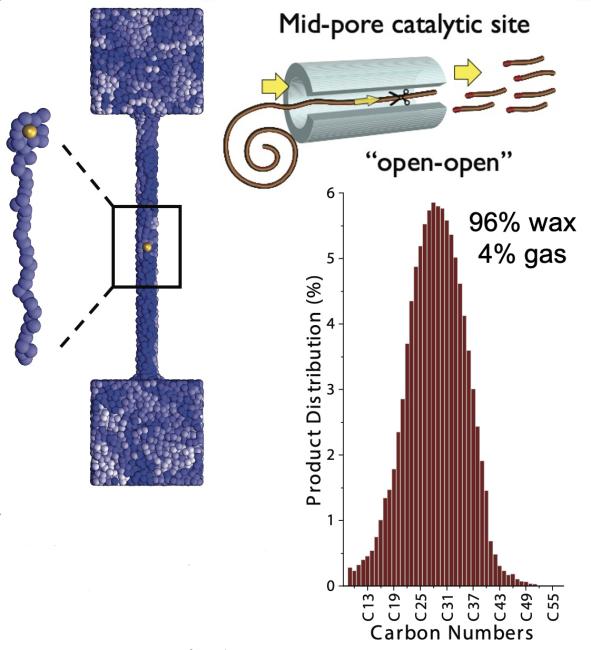
The exceptional catalytic activity and selectivity of a new mesoporous silica (mSiO2)-shell/Pt/mSiO2-core architecture for hydrogenolysis of diverse polyolefin samples into a narrow C28-centered normal hydrocarbon distribution, is understood by extended polymer conformations and fast and quasi-irreversible diffusion of products away from active sites.
Significance and Impact
The new mSiO2/Pt/mSiO2 catalyst efficiently uses H2 for polyolefin deconstruction, with >96% of H2 generating C28-average waxes and preventing gas (especially methane) formation, key for enabling a circular plastic economy.
Research Details
- A new “open-open” catalytic architecture was created with Pt localized between two mesoporous domains;
- H2 consumption and the entire molecular weight distribution reveal kinetics of C–C cleavage and polymer conversion;
- Molecular dynamics (MD) simulations suggest that “open-open” pores lead to better product diffusion away from Pt active sites, limiting gas production.
Tennakoon, A.; Wu, X.; Meirow, M.; et al. J. Am. Chem. Soc. 2023, 145, 17936-17944. https://doi.org/10.1021/jacs.3c05447
iCOUP, an EFRC Supported by Basic Energy Sciences
Work was performed in Ames, Northwestern, and ANL