
 Scientific Achievement
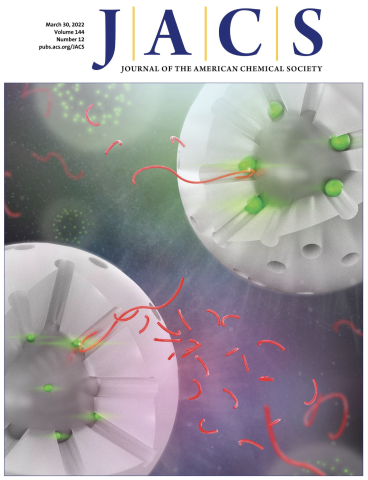
Through confinement into a mesoporous shell/catalyst/core architecture, activity of efficient Pt nanoparticles (NPs) for carbon-carbon bond hydrogenolytic cleavage of polyolefins is disentangled from their selective production of hydrocarbon waxes with specific average chain lengths.
Significance and Impact
This architecture-governed selectivity in the deconstruction of polyethylene provides a design strategy to target narrow molecular weight
distributions of desired products for application in plastic upcycling, while utilizing small quantities of metal NP catalysts.
Research Details
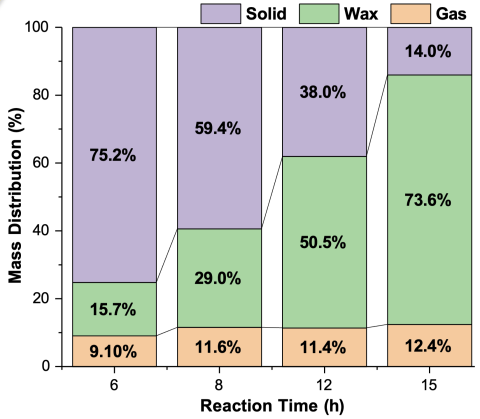
- Architectural effects on activity, product length, and selectivity can be systematically studied through independent variation of core, metal NP, and shell dimensions and properties, and pore diameter.
- A population balance “lumped” kinetic model shows that catalytic PE hydrogenolysis activity is higher with smaller Pt NPs in the mSiO2/Pt/SiO2 material, following the trend: 1.7 nm > 2.4 nm > 5.0 nm.
- Small, medium, or large Pt NPs in three mSiO2/Pt/SiO2 catalysts provide high yields (>70%) of equivalent C26-centered waxy hydrocarbons.
- mSiO2/Pt/SiO2 selectively deconstructs polymer chains rather than short chains
Wu, X.; Tennakoon, A.; Yappert, R.; Esveld, M.; Ferrandon, M. S.; Hackler, R. A.; LaPointe,
A. M.; Heyden, A.; Delferro, M.; Peters, B.; Sadow, A. D.; Huang, W. “Size-Controlled Nanoparticles Embedded in a Mesoporous Architecture Leading to Efficient and Selective Hydrogenolysis of Polyolefins.” J. Am. Chem. Soc., 2022, 144, 5323-5334. https://doi.org/10.1021/jacs.1c11694
iCOUP, an EFRC Supported by Basic Energy Sciences
Work was performed at Ames Lab, UIUC, ANL, Cornell, UofSC