
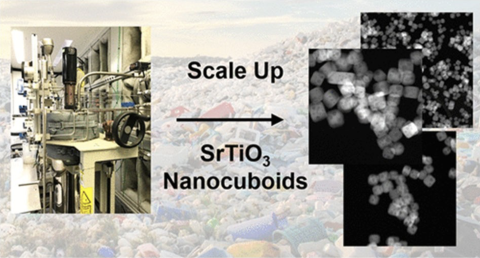
Scientific Achievement
A scalable synthesis of Pt/SrTiO3 hydrogenolysis catalysts has been developed that retains the catalyst’s desirable properties, such as catalyst stability, and its performance for the upcycling conversion of polyolefins to valuable, lower molecular weight products.
Significance and Impact
Control of global synthetic parameters can ensure that Pt/SrTiO3 catalyst physical properties are retained at various synthetic scales. Increased synthetic output of Pt/SrTiO3 is a key step and demonstrates that upcycling of polyethylene on manufacturing-relevant scales is attainable.
Research Details
- SrTiO3 nanocuboid supports of average sizes from 25-80 nm were synthesized with a high fraction of nanocuboids per batch by avoiding CO2 uptake
- SrTiO3 synthesis was increased from a 1g to 20-40g scale while maintaining an equivalent rounded nanocuboid morphology
- Dispersed Pt nanoparticles were deposited by strong electrostatic adsorption, a method more amenable to scale up than previously reported atomic layer deposition routes
- Pt/SrTiO3 synthesized by these methods exhibited excellent conversion of polyethylene to low molecular weight products
Peczak, I.L.; Kennedy, R.M.; Hackler, R.A.; Wang, R.; Shin, Y., Delferro, M.; Poeppelmeier, K.R., Scalable Synthesis of Pt/SrTiO
Hydrogenolysis Catalysts in Pursuit of Manufacturing-Relevant Waste Plastic Solutions. ACS Applied Materials and Interfaces 2021, 13, 58691. DOI: https://doi.org/10.1021/acsami.1c18687
iCOUP, an EFRC Supported by Basic Energy Sciences