
Scientific Achievement
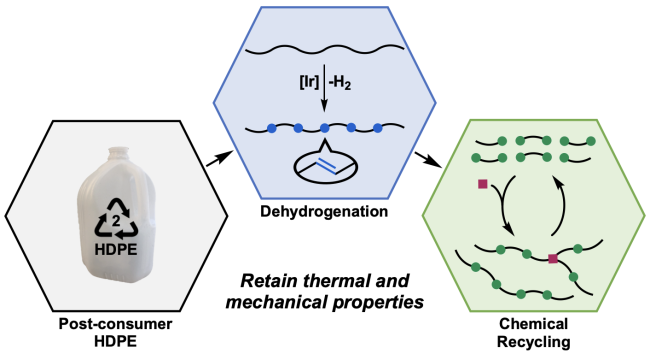
Dehydrogenation of post-consumer HDPE results in tunable unsaturation along the polymer chain priming it for further chemical reactivity and incorporation of cleavable linkages. These functionalized macromolecules could then be repolymerized with a crosslinker resulting in similar thermal and mechanical properties to the original HDPE jug.
Significance and Impact
Currently, HDPE that is processed through mechanical recycling methods rarely make its way back to the original intended application since degradation of material properties and contamination occur. This work highlights the transformation of plastic waste using catalytic transformations to obtain a new HDPE-like polymer that maintains similar thermal and mechanical properties to the original material.
Research Details
- An Ir-POCOP pincer catalyst was utilized to introduce unsaturation into polyethylene chains from post-consumer HDPE waste under hydrogen acceptorless conditions at low catalyst loadings.
- The dehydrogenated HDPE waste underwent cross-metathesis to form macromonomers with molecular weights dependent on the degree of unsaturation.
- After hydrogenation and partial aminolysis, these macromonomers were polymerized to yield a material with comparable mechanical and thermal properties to HDPE.
Arroyave, A.; Cui, S.; Lopez, J.C.; Kocen, A. L.; LaPointe, A. M.; Delferro, M.; Coates, G. W. Catalytic Chemical Recycling of Post-Consumer Polyethylene. J. Am. Chem. Soc. 2022, 144 (51), 23280-23285. https://doi.org/10.1021/jacs.2c11949
Supported by the Institute for Cooperative Upcycling of Plastics (iCOUP), an Energy Frontier Research Center funded by the U.S. Department of Energy, Office of Science, Basic Energy Sciences under contracts DE-AC-02-06CH11357 and DE-AC-02-07CH11358.
Work performed at Argonne National Lab and Cornell University