
Scientific Achievement
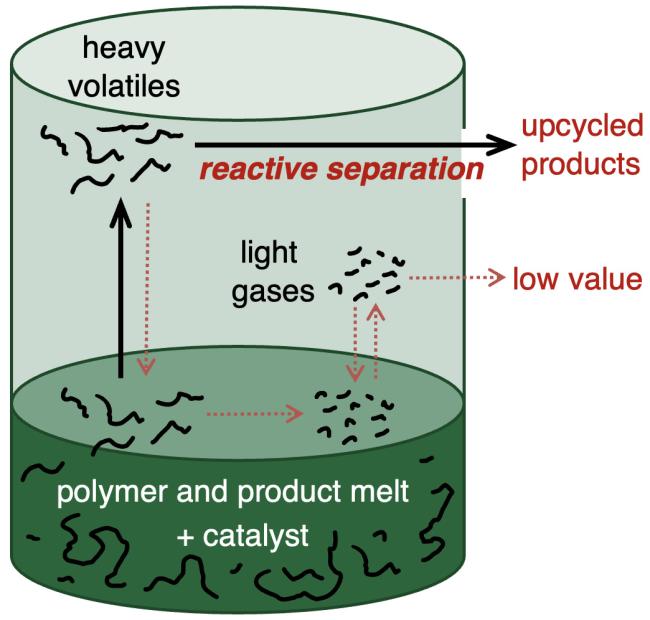
Polymer deconstruction combined with reactive separation, described by a population-balance kinetic model, reveals a significant effect of volume on selectivity, increases the yield of liquids, avoids formation of light gases, and shows that terminal alkenes are primary products in hydrogenolysis.
Significance and Impact
Reactive separation provides a complementary strategy to catalyst design to achieve selective conversion of polyolefins to upcycled liquids and avoiding the formation of light gases.
Research Details
- Reactive separation of upcycled products was achieved in a semi-batch reactor, which connects an autoclave to a condenser to directly collect products of polyolefin hydrogenolysis.
- Henry’s law vapor phase equilibria and population balance equations predict catalysis in a two-phase reactor.
- Perturbation of condensed-phase / gas-phase equilibria (Le Chatelier’s principle) is accomplished by removing gas-phase species.
Wang, Y.-Y.; et al. ACS Catal. 2024,14, 2084. https://doi.org/10.1021/acscatal.3c04987
Kim, C. A.; et al. Langmuir 2024, 40, 4096. https://doi.org/10.1021/acs.langmuir.3c03004
iCOUP, an EFRC Supported by Basic Energy Sciences
Work was performed at Ames, UIUC, UofSC