
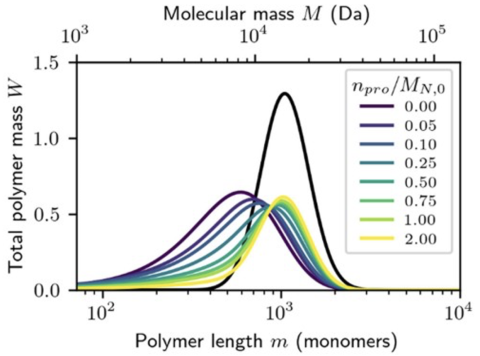
 Scientific Achievement
Extended traditional rate equations for discrete species to a continuum of polymer reactants and intermediates. Quantitatively and consistently embedded models for kinetics at the molecular scale into models for larger scales.
Significance and Impact
Provides theoretical framework to predict molecular weight evolution from simulations and ab initio calculations, to extract kinetic parameters from molecular weight evolution data, and to recognize signatures of processive vs. non-processive catalyst operation.
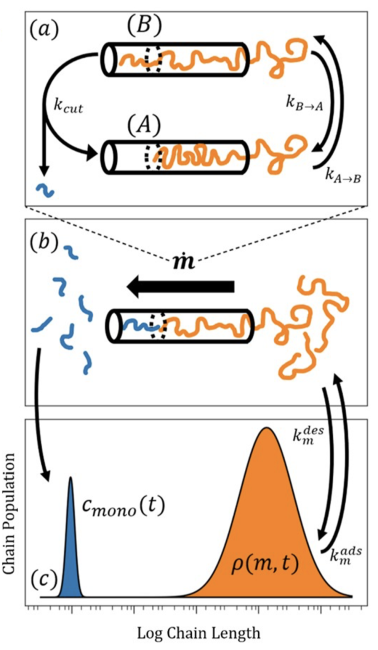 Elementary steps of processive cleavage for polymer in pore:
- Microkinetic model gives rate law for processive TOF in pore
- Combine with model for adsorption/desorption into/from pores
- Embed adsorption and TOF expressions in coupled population balance models, one for the bulk polymers and one for adsorbed polymers
- Apply pseudo-steady-state- approximation to adsorbed population
- Predict molecular weight evolution and processivity number during depolymerization
ACS Catal. 2022, 12, 10353-10360. doi:https://doi.org/10.1021/acscatal.2c01195
iCOUP, an EFRC Supported by Basic Energy Sciences
Work was performed at UIUC