
Scientific Achievement
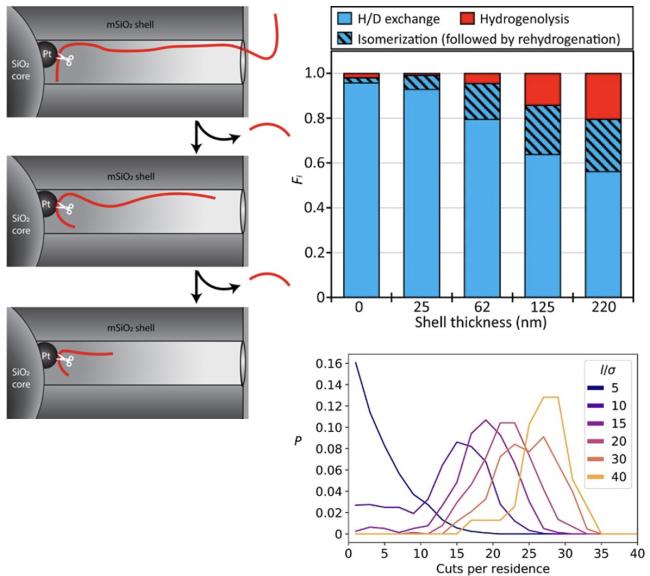
The extent of processivity, defined as the number of cleavage steps performed by a catalyst on a single polymer chain before the chain desorbs, showed a positive correlation with the distance a polymer molecule travels through a pore to reach an active site, as determined by isotopic labeling and molecular dynamics (MD) simulations.
Significance and Impact
Processivity provides a catalyst-design strategy to improve selectivity in polymer deconstructions. Insight into architectural features of porous catalysts, namely the distance through a pore to precisely placed active sites, enables catalyst design to enhance selectivity in polymer upcycling.
Research Details
- In situ MAS NMR monitored the Pt-catalyzed conversion of labeled PE to determine the ratio of hydrogenolysis and dehydrogenation, providing a metric of cuts per residence, and thus processivity.
- mSiO2-shell/Pt/SiO2-core catalysts with core-confined Pt showed an increasing ratio (i.e., higher processivity) with longer mesopores
- MD simulations confirmed that longer channels lead to far greater cuts per residence, primarily due to increased residence times
Zhao, T. Y.; Meirow, M.; et al. Macromolecules, 2023, 56, 4287−4295. https://doi.org/10.1021/acs.macromol.3c00474
iCOUP, an EFRC Supported by Basic Energy Sciences
Work was performed at AMES, Northwestern, ANL and Cornell