
Scientific Achievement
Established mechanistic role of metal oxide support on the catalytic deconstruction of polyolefins under H2.
Significance and Impact
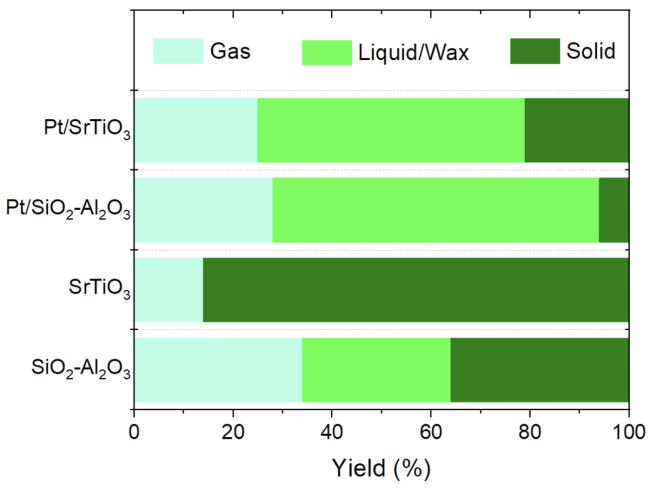
The lack of acidity and increased stability of Pt/SrTiO3 facilitates polymer deconstruction via hydrogenolysis, generating products that can be used directly as lubricants, whereas higher acidity and lower stability of Pt/SiO2-Al2O3 enables polymer deconstruction via competing hydrogenolysis and hydrocracking, generating mixtures of products that require further separation.
Research Details
- High-throughput synthesis of Pt/support catalysts
- Determination of acid-case properties of Pt/support catalysts
- Catalytic hydrogenolysis under identical conditions
- Analysis of gas, liquid, and solid products
Lamb, J. V. et al. Supported Platinum Nanoparticles Catalyzed Carbon–Carbon Bond Cleavage of Polyolefins: Role of the Oxide Support Acidity. ACS Appl. Mater. Interfaces 2024, 16 (9), 11361-11376. https://doi.org/10.1021/acsami.3c15350