
Scientific Achievement
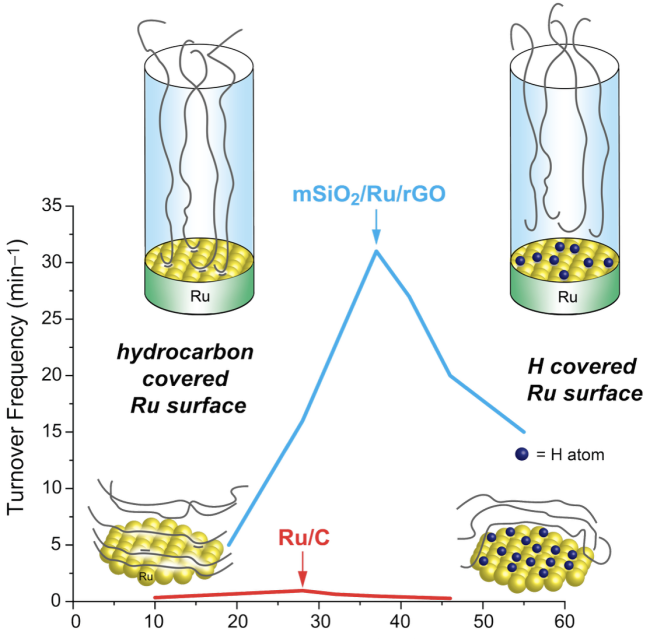
Localized confinement in mesopores increases the rate and selectivity of Ru-catalyzed C–C bond cleavage in polyolefin hydrogenolysis by influencing polymer chains' contact with active sites and their conformations.
Significance and Impact
Value-added chemical manufacturing from polyolefin feedstocks requires the high activity and selectivity and low methane co-production achieved by the localized and pore-encapsulated ruthenium catalyst
Research Details
- We created a new class of mesopore-confined and localized Ru nanoparticle catalysts, mSiO2/Ru/rGO.
- C–C bond cleavage rate measurements reveal a more severe volcano-like reaction order dependence on H2 inside mesopores.
- A kinetic model of H2/rate data indicates that cleavable chains in pores require less space on Ru surfaces.
Tonk, Sun, Bamidele, and co-workers, J. Am. Chem. Soc., 2026, 148, 27143-27155. DOI: https://doi.org/10.1021/jacs.6c02867
XAS measurements performed at the Advanced Photon Source operated by Argonne National Lab and SAXS and WAXS at 11BM of the National Synchrotron Light Source II operated by Brookhaven National Laboratory