
Scientific Achievement
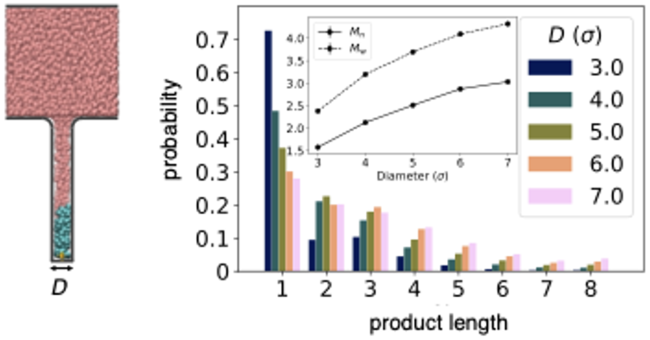
Molecular dynamics simulations with explicit chain cleavage events show that the pore diameter of a catalytic support particle controls the product distribution by (1) modulating chain residence times within the pore and (2) biasing which bonds are cleaved due to conformational restrictions.
Significance and Impact
Results offer a mechanistic explanation for an experimentally observed product distribution trend related to a tunable physical parameter of a catalytic architecture for plastics’ upcycling.
Research Details
- Designed generic particle-based model of concentrated polymer solution interacting with a pore containing an active cleavage site
- Demonstrated that model qualitatively reproduces trend that wider pores yield larger products
- Quantified the diameter-dependence of intrapore chain residence times and conformations, and showed how these are related to the lengths of the products produced by the cleavage reactions
Meirow, M.; Luijten, E. Coarse-Grained Modeling of Polymer Cleavage within a Porous Catalytic Support. ACS Macro Lett. 2023, 12, 189–194. https://doi.org/10.1021/acsmacrolett.2c00682
iCOUP, an EFRC Supported by Basic Energy Sciences
Work performed at Northwestern University.