
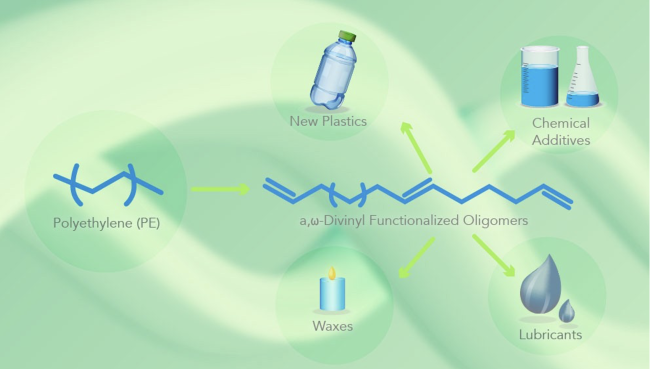
Scientific Achievement
Polyethylenes were upgraded to value-added a,w-divinyl-functionalized oligomers with tunable chain lengths via a three-step process. Techno-economic analysis (TEA) projected a profitable process on an industrial scale with a 50% IRR.
Significance and Impact
Today, only 9% of plastic waste is recycled. Polyethylene (PE) is the most frequently used and discarded plastic with annual production volume of 23 million metric tons. The molecular upcycling process described herein provides value-added intermediates from waste polyethylene that can be used in the synthesis of lubricants, as well as transformed into new polymers.
Research Details
- Brominated polyethylene was isolated in good yields, 86 wt% based on starting PE.
- Elimination of bromide followed by ethenolysis afforded a,w-divinyl- functionalized oligomers in near quantitative yields > 90 wt%.
M. Zeng, Y.-H. Lee, G. Strong, A. M. LaPointe, A. L. Kocen, Z. Qu, G. W. Coates, S. L. Scott, and M. M. Abu-Omar, ACS Sustainable Chem. Eng. 2021, 9, 13926-13936. Publication: https://doi.org/10.1021/acssuschemeng.1c05272
iCOUP, an EFRC Supported by Basic Energy Sciences
Work was performed at UCSB and Cornell