
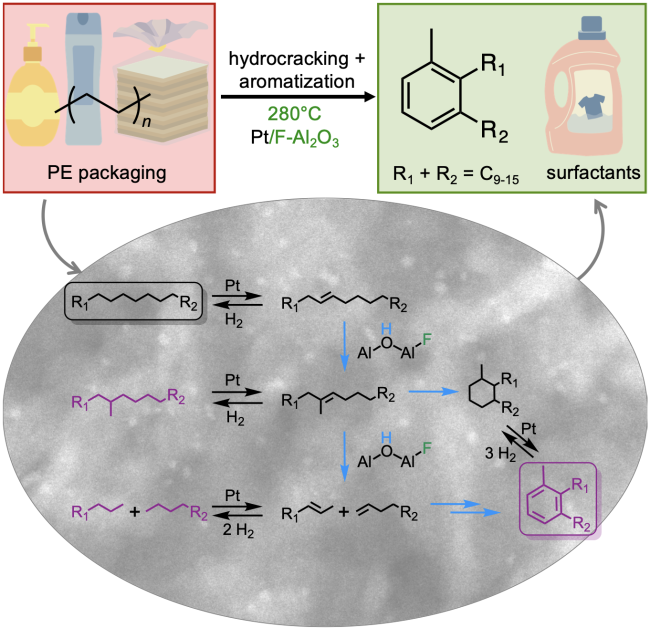
 Scientific Achievement
- The rates of tandem hydrogenolysis/aromatization of polyethylene and the selectivity to alkylaromatics are greatly enhanced by the synergy between strong Brønsted acid sites and Pt nanoparticles.
- Pt is responsible for hydrogenation/dehydrogenation, while Brønsted acid sites convert olefins to carbenium ions that readily undergo skeletal transformations (isomerization, C-C bond scission, cyclization).
Significance and Impact
- Bifunctional catalysts improve the viability of chemical upcycling for waste polyolefins to value-added surfactant-range alkylaromatics.
- This work also advances quantitative catalyst assessment and product analysis in polyolefin upcycling.
Research Details
- Pt/F-Al2O3 and physical mixtures of Pt/g-Al2O3 and F-Al2O3 are effective.
- The rates of C-C bond scission, alkane isomerization, and aromatization all correlate linearly with the total number of strong Brønsted acid sites.
- Nanoscale proximity between Pt and acid sites is not required to convert alkanes to alkylaromatics.
Sun et al., Chem 2023, 9, 2318–2336. https://doi.org/10.1016/j.chempr.2023.05.017
iCOUP is an EFRC, supported by Basic Energy Sciences
Work was performed at UCSB, UIUC and Cornell