
Scientific Achievement
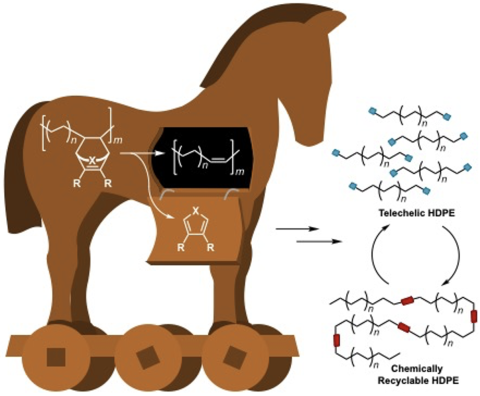
Chemically recyclable high-density polyethylene (HDPE) was synthesized from partially unsaturated polyethylene, generated from a thermal retro-Diels-Alder deprotection of norbornene-containing PE as the “Trojan Horse”."
Significance and Impact
Chemically recyclable polyolefins that can be repeatedly disassembled into smaller fragments, purified, and polymerized again are sustainable alternatives to conventional polyolefins. “Masked” unsaturation was introduced into polyethylene using oxa-norbornadiene comonomers. The resulting copolymers undergo a thermally triggered triggered deprotection and are precursors for chemically recyclable HDPE.
Research Details
- Pd phosphine-sulfonate polymerization catalysts and oxa-norbornadiene comonomers were optimized for comonomer incorporation and thermally triggered retro-Diels Alder reactions
- Unsaturated polyethylene was formed by heating to 165 °C in solution or in the melt
- Telechelic hydroxyester HDPE was prepared via olefin metathesis and subsequent hydrogenation
- Polymerization of the telechelic HDPE yielded ester-linked HDPE with similar thermal and mechanical properties to commercial HDPE
- Ester-linked HDPE could be repeatedly depolymerized and repolymerized
Parke, S.; Lopez, J. C.; Cui, S.; LaPointe, A. M.; Coates, G. W. Angew. Chem. Int. Ed., 2023, 62, e202301927. https://doi.org/10.1002/anie.202301927
iCOUP, an EFRC Supported by Basic Energy Sciences