
Scientific Achievement
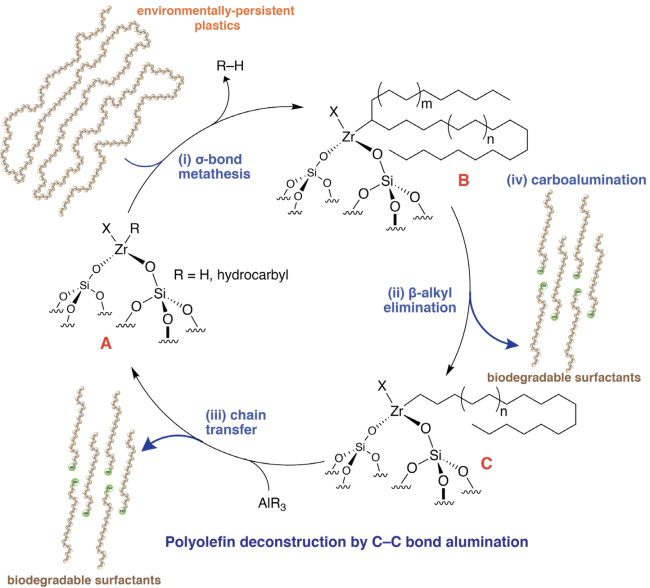
Restructuring and functionalizing hydrocarbons. Tandem C–C bond cleavage and Al installation at newly created chain ends is catalyzed by surface- supported hydridozirconium sites, generated in situ from air-stable catalyst precursors.
Significance and Impact
This catalytic deconstruction of polyolefins, using Earth-abundant Zr catalyst and Al reactants, into valuable, biodegradable surfactant and detergent precursors, provides an economically and environmentally sustainable end-of-life for single-use plastics.
Research Details
- Organoaluminum reagents generate and inoculate air- and moisture-sensitive catalytic ZrH surface sites.
- Oligomerylzirconium formed by C–C bond cleavage
reacts with AlR3 to form versatile alkylaluminum species, which transform into products with O2 or CO2. - Products are established as terminal fatty alcohol
chains or acids by MALDI-TOF-MS and 1D and 2D NMR.
Work was performed at Ames Laboratory and ANL
U. Kanbur, G. Zang, A. L. Paterson, P. Chatterjee, R A. Hackler, M. Delferro, I. I. Slowing, F. A. Perras, P. Sun, A. D. Sadow Chem 2021, 7, 1347–1362. https://doi.org/10.1016/j.chempr.2021.03.007