
Scientific Achievement
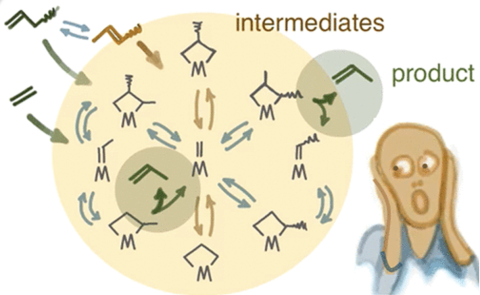
A microkinetic model for isomerizing ethenolysis (IE) was developed and solved for the first time, to determine reaction orders of two reactants.
Significance and Impact
Ethenolysis of polyethylene produces propylene, providing a strategy to recover the CH2s in discarded polyethylene. Previous kinetic models can not explain the experimental propylene generation rate. To understand the discrepancy, a microkinetic model for the isomerizing ethenolysis reaction is needed. The model provides reactant concentration range for optimal production rate.
Research Details
- Experimental data of IE was analyzed and modeled as two steps. Model predictions were verified by experimental data.
- The microkinetic model was solved numerically under different reaction rate constants and reactant concentrations. Reaction order for both reactants was determined based on the model.
Z. Chen, A. D. Sadow, B. Peters, ACS Catal. 2024, 14, 6339–6348. https://doi.org/10.1021/acscatal.4c00465
Work was performed at University of Illinois at Urbana-Champaign and Ames National Laboratory
iCOUP, an EFRC Supported by Basic Energy Sciences