
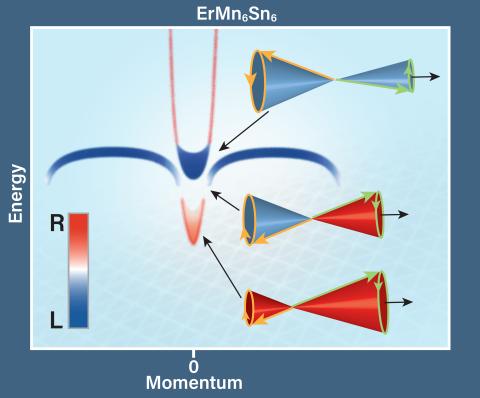
Researchers at the U. S. Department of Energy’s (DOE) Ames National Laboratory have discovered a way to control the handedness of magnons, tiny magnetic waves that can carry information through materials. By changing the material’s magnetic state with an external magnetic field, they were able to switch magnon behavior, a finding with potential applications in quantum information and quantum computing technologies.
Magnons are excitations—tiny waves of magnetic motion traveling through magnetic materials—that trace paths in a right-handed or left-handed direction, like a spinning top moving clockwise or counterclockwise. Because magnons provide a means to transmit energy and information without moving electrical charge, scientists are exploring them as potential building blocks for future high-efficiency computing applications.
One of the best places to study magnon handedness is in ferrimagnets, a class of materials that naturally host both right- and left-handed magnons. Ferrimagnets contain two different types of magnetic atoms whose magnetic moments point in opposite directions. Because the size of their magnetic moments are unequal, they do not entirely cancel each other out. This allows scientists to investigate how the two different types of magnons interact within a given material.
Ames Lab Scientist Rob McQueeney leads the group that made this discovery while studying magnetic excitations in Kagome metals, a class of quantum materials that possess unusual magnetic behavior. They observed that magnons in some materials, such as TbMn6Sn6, cross without interacting, while in others, such as ErMn6Sn6, they interact and avoid crossing.
“We looked at it and said, ‘Well, that's funny. I wonder why that is.’ And then we started to realize, wait that's a left-handed magnon. And that's a right-handed magnon. Okay, now they're mixing.” said McQueeney.
Scientists already knew that ferrimagnets possess both left- and right-handed magnons forming two separate bands of magnetic excitations. Normally, it takes different energies to excite right-handed and left-handed magnons. McQueeny’s group discovered that under the right conditions, the two states can mix, making it possible to switch a magnon’s handedness using relatively little energy.
“Magnons have certain advantages for moving information,” McQueeney explained. “But manipulating the handedness was not a solved problem. And now it is.”
Because magnons can carry information without moving electrical charge, they can carry information more efficiently than conventional electronic technologies. The ability to easily control and combine right- and left-handed magnons offers new possibilities for future magnetic-based quantum information technologies.
This research is further discussed in: “Chiral Magnon Mixing by Symmetry-Breaking in Collinear Ferrimagnets,” written by Dhurba R. Jaishi, Tyler J. Slade, S. X. M. Riberolles, Bing Li, Tianxiong Han, D. M. Pajerowski, D. L. Abernathy, Barry Winn, Melissa Graves-Brook, B. G. Ueland, and R. J. McQueeney, and published in Physical Review Letters.
Ames National Laboratory is a U.S. Department of Energy Office of Science National Laboratory operated by Iowa State University. Ames Laboratory creates innovative materials, technologies, and energy solutions. We use our expertise, unique capabilities, and interdisciplinary collaborations to solve global problems.
Ames Laboratory is supported by the Office of Science of the U.S. Department of Energy. The Office of Science is the single largest supporter of basic research in the physical sciences in the United States and is working to address some of the most pressing challenges of our time. For more information, please visit https://energy.gov/science.