
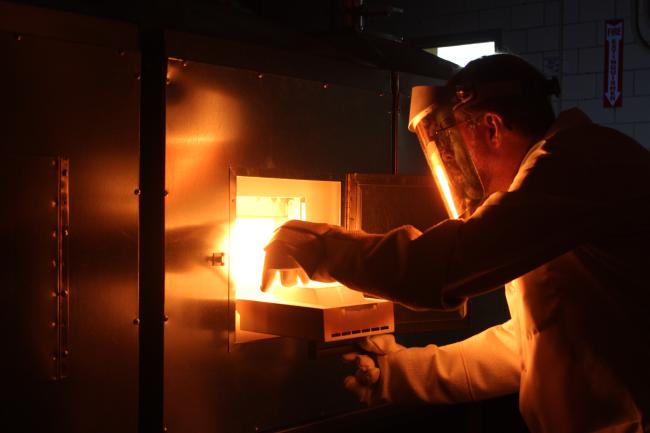
Understanding how materials form is critical to discovering new ones. Researchers at the U. S. Department of Energy’s (DOE) Ames National Laboratory have found that a technology they originally developed for crystal growth can also help map the conditions under which materials form, providing data that may improve materials discovery efforts. Experimental data from these studies can also help researchers evaluate and improve the Super Intelligence (SI) and computational tools used to predict new materials.
Crystal growth is a key part of materials discovery which involves heating and cooling mixtures of elements, allowing researchers to study how materials form and determine whether a new material has useful properties. These experiments are typically conducted in crucibles, heat-resistant ceramic containers designed to hold materials at the high temperatures required for crystal growth.
The Canfield Crucible Set (CCS) was originally developed in 2015 by Ames Lab senior scientist Paul C. Canfield, who is also a Distinguished Professor of Physics and Astronomy at Iowa State University. The system was originally developed to improve crystal-growth experiments by allowing researchers to cleanly separate newly formed crystals from the remaining liquid material. Unlike earlier approaches, it also allowed that liquid to be recovered for further analysis and reuse.
Now sold to over 300 labs in 30 countries across six continents, the Canfield Crucible Sets have continued to evolve beyond their original purpose as specialized crystal-growth tools. Over the past decade, Ames Lab scientists have refined the technology, allowing scientists to optimize crystal-growth conditions, expand phase diagrams, and further their understanding of how materials form. Researchers soon realized that recovering the remaining liquid from crystal-growth experiments could do more than reduce waste or improve efficiency. It also provided new information about how materials crystallize.
Canfield explained that using the CCS to cleanly separate grown crystals from remaining liquid allows for a process called fractionation. In this process, some crystal growth takes place over a limited temperature range with the decanted liquid being recovered and reused for the next, lower temperature step. Over the course of a week, researchers can repeat the crystal growth process at progressively lower temperature ranges, allowing them to map out exactly when given crystalline phases grow. Mapping these phases makes it possible for researchers to quickly find the best temperature conditions for growing a particular crystal phase. Under some conditions, this approach can also produce crystals that are 10–100 times larger than those obtained otherwise.
While this is one use of fractionation, it is not the only one. Material scientists use graphical tools called phase-diagrams that map the physical state (solid, liquid, gas) of a material under different conditions based on temperature, composition, and pressure. Some are experimentally validated, while others are based on predictions.
A binary phase diagram is based on a mixture of two elements, a ternary is based on three, and a multinary phase diagram includes four or more elements. Currently, experimental data that can be used to test the accuracy of these calculated phase diagrams is limited. Canfield and his team are working to overcome this limitation.
“Fractionation is now something that we're using more broadly to try not only to get larger crystals of materials we want, but it also allows us to more carefully explore phase diagrams,” said Canfield. “We are now using the CCSs for a wide-ranging research program we call ABCD (Anchoring, Benchmarking and Challenging of computational prediction models for enhanced Discovery of materials).
“Most binary phase diagrams have been figured out experimentally; most ternary phase diagrams don't exist at all.” explained Canfield. “With this approach, we have the ability to put some data points onto ternary phase diagrams. And with these data points, our hope is we can anchor and benchmark phase diagram prediction.”
In addition to helping to improve calculated phase diagrams, this new experimental data could support materials discovery. The approach has already contributed to the discovery of new classes of quantum materials and other materials with unusual properties that open new areas of scientific investigation. Currently, discovery of a new material is based on computational data and trial-and-error in the experimental stage. Many researchers are looking to machine learning and SI to speed up the process.
“Machine learning takes all known structures and tries to find new examples. Well, if it's an unknown structure, machine learning fails. Then it needs to be AI, or it needs to be a genetic algorithm that we use,” Canfield said. “If these prediction engines cannot predict that material, there's something wrong with them, or it's showing what the limitations are.”
Discovery of new materials with previously unknown structures forms the “Challenge” step of the ABCD approach. These discoveries can open entirely new areas of investigation while providing rigorous tests for computational prediction tools.
“A new structure is a ‘teaching moment’ for the SI prediction engines,” said Canfield. “If they can reliably predict a new, previously unknown structure, then they become more accurate. The goal being that with enough Anchoring, Benchmarking and Challenging, then the prediction engines will become trusted tools that can accelerate the search for and discovery of new materials.”
This research is further discussed in “Use of Frit-Disc Crucible Sets to Make Solution Growth More Quantitative and Versatile,” written by Paul C. Canfield and Tyler J. Slade, and published in Zeitschrift für anorganische und allgemeine Chemie.
Ames National Laboratory is a U.S. Department of Energy Office of Science National Laboratory operated by Iowa State University. Ames Laboratory creates innovative materials, technologies, and energy solutions. We use our expertise, unique capabilities, and interdisciplinary collaborations to solve global problems.
Ames Laboratory is supported by the Office of Science of the U.S. Department of Energy. The Office of Science is the single largest supporter of basic research in the physical sciences in the United States and is working to address some of the most pressing challenges of our time. For more information, please visit https://energy.gov/science.