
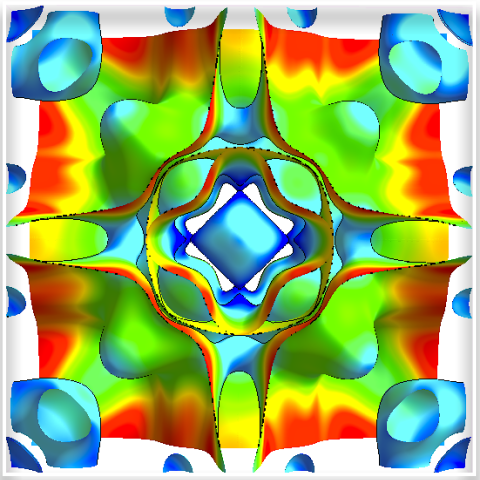
Scientists at Ames National Laboratory, in collaboration with Indranil Das’s group at the Saha Institute of Nuclear Physics (India), have found a surprising electronic feature in transitional metal-based compounds that could pave the way for a new class of spintronic materials for computing and memory technologies. Spintronics, a field that harnesses the spin of electrons in addition to their charge, promises breakthroughs in technologies such as brain-like computers and memory devices that retain data without power.
The unexpected feature was found in Mn₂PdIn, a Heusler compound—a type of alloy valued for its tunable magnetic and electronic properties. These alloys can exhibit behaviors not seen in their individual elements, making them prime candidates for spintronic applications.
Traditional electronic devices rely on the charge of electrons, while spintronics also harness their intrinsic spin, a quantum mechanical entity that carries magnetic information. The anomalous Hall effect (AHE) is a useful spintronic phenomenon. It provides a way to read and control spin-based signals electrically. Until now, the AHE has most often been observed in clean, single-crystal samples with large magnetic moments. Detecting a strong AHE in a polycrystalline material with a very low magnetic moment is rare and important because polycrystalline samples are easier to make and low-moment materials can operate with less energy.
“This was exactly our aim—to make a material with a very low magnetic moment that still produces a strong AHE,” said Anis Biswas, staff scientist at Ames Lab. “A lower magnetic moment means it takes less energy to manipulate spins, so this could lead to much more energy-efficient memory and other spintronic devices. It’s an important step toward practical, low-power functional materials.”
Prashant Singh, a staff scientist at Ames Lab, explained that the effect comes from Fermi-surface nesting, when parts of a material’s electronic structure line up in just the right way, causing the electrons to rearrange and produce novel behavior.
“By tuning the electronic structure, we were able to trigger this nesting and explain the anomalous Hall signal we saw,” Singh said. “It’s rare to find this kind of feature in these materials, so uncovering it made the work especially exciting.”
Yaroslav Mudryk, another scientist at Ames Lab, emphasized the significance of observing the anomalous Hall effect in a polycrystalline material. He also highlighted the collaborative spirit behind the discovery, noting the important contributions of early-career researchers.
“Ames Lab’s expertise in magnetism and electronic-structure research combined with our collaborators’ strength in investigating transport properties allowed us to understand these systems in a much more proactive and predictive way,” said Mudryk.
This research was published in, “Fermi Surface Nesting and Anomalous Hall Effect in Magnetically Frustrated Mn2PdIn,” written by Afsar Ahmed, Arnab Bhattacharya, Prashant Singh, Ajay Kumar, Tukai Singha, Anis Biswas, Yaroslav Mudryk, and I. Das, and published in Advanced Functional Materials,.
Ames National Laboratory is a U.S. Department of Energy Office of Science National Laboratory operated by Iowa State University. Ames Laboratory creates innovative materials, technologies, and energy solutions. We use our expertise, unique capabilities, and interdisciplinary collaborations to solve global problems.
Ames Laboratory is supported by the Office of Science of the U.S. Department of Energy. The Office of Science is the single largest supporter of basic research in the physical sciences in the United States and is working to address some of the most pressing challenges of our time. For more information, please visit https://energy.gov/science.