
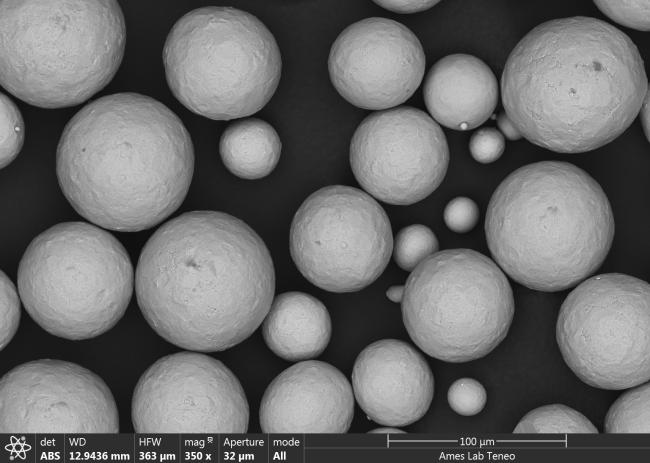
 The U. S. Department of Energy Ames National Laboratory has been a leader in metal powder synthesis and metallurgy for more than 40 years. Now, Ames Lab is building on that expertise with a new refractory metal powder atomization system that will help researchers develop materials for extreme environment applications, such as gas turbines and fusion energy systems.
“Ames Lab has a long history of making specialized powders that other places simply can’t,” said Ames Lab Scientist Jordan Tiarks. “This system builds on that foundation but pushes us into a new temperature and materials regime that’s been largely out of reach.”
Powdered metals are crucial for American industry as they enable the precise manufacturing of complex components and specialized alloys that are difficult or even impossible to create using traditional methods. The new system addresses a critical gap in the nation’s ability to supply powder materials for high‑melting‑temperature alloys.
The new system can process materials at temperatures up to 3400 °C with production rates up to one kilogram per minute. These capabilities allow researchers to produce the quantities of powder needed to develop, test, and scale novel materials for extreme environments, helping accelerate their adoption by U.S. industry.
Why refractory metal powders?
Currently, land-based and aerospace gas turbines are made from nickel- or cobalt- based superalloys. They require elaborate cooling systems and costly thermal barrier coatings to operate at the extremely high temperatures necessary for optimal efficiency. To improve performance and reduce cooling requirements, researchers are looking to new alloys that can withstand extreme temperature conditions.
Refractory metals, such as tungsten, molybdenum, niobium, and vanadium have extremely high melting points and can be used to create alloys that can operate at much higher temperatures than conventional metals. Unfortunately, refractory based alloys are extremely difficult to process into useful shapes like turbine blades or other complex components using traditional methods. Powder metallurgy can overcome many of these manufacturing challenges, but it requires the high-quality metal powders this research is focused on producing.
One of the goals of ARPA-E’s ULTIMATE program is to develop alloys and coatings for next-generation turbine components. In early phases of the program, researchers used advanced computation and AI-enabled design programs to find promising new materials for these applications. However, they often struggled to obtain powders at the scale and quality needed to test and validate those materials.
“Teams had great ideas on paper, but they were running into year‑plus waits just to get the powders they needed for testing,” said Tiarks. “ARPA‑E recognized that what was missing was not just new alloys but also access to equipment capable of making sufficient quantities of high-quality powders of these alloys for research and development. Ames Lab was a natural place to build that capability because we’ve been doing powder metallurgy at a high level for decades.”
How the new equipment works
Refractory alloys can be difficult to manufacture using traditional casting, forging, and machining methods, particularly when producing complex components. Powder metallurgy offers an alternative approach, making new alloys and component designs possible. However, many atomization systems were not designed to process these high-temp materials. Ames Lab’s existing equipment faced temperature and materials-compatibility limitations that can make refractory alloys difficult to produce..
The new system at Ames Lab overcomes this limitation by using a transferred arc plasma process. Rather than requiring a specially manufactured electrode, the system uses high-energy plasma to locally melt the feedstock before atomization. The feedstock for this process can be in any physical form, including bars and chunks, as long as the material has a consistent composition throughout
The melting takes place inside a water-cooled copper hearth, which allows the outer layer of the molten material to freeze against the copper to form a thin protective layer of solid material. This layer (called a “skull”) acts as a liner between the ultra-hot molten material and the cooled copper.
Another important part of the process is that only a small volume of the material is molten at any one time.
“Local melting gives us two big advantages,” explained Tiarks. “First, it’s safer—if anything goes wrong, you don’t have a huge vat of 3400‑degree metal to manage. Second, the material spends less time at high temperature, which helps us maintain purity and control reactivity.”
Moving forward
Researchers are currently training with the new equipment using commercial titanium alloys and will expand to materials including molybdenum and nickel‑based superalloys. These materials will help operators map the system performance. They will then shift toward producing powders for research projects that target next generation turbine components, fusion energy systems, and other extreme environment applications. One application is Ames Lab's ongoing fusion materials research, including a collaboration with Pacific Northwest National Laboratory to develop advanced structural materials for fusion energy systems. The work focuses on materials capable of surviving the extreme conditions encountered at a fusion reactor’s first wall.
The refractory atomizer complements a suite of atomizers at Ames Lab. Designed for materials that require much higher processing temperatures, it expands the laboratory's ability to produce powders from refractory metals and alloys. For conventional alloys that can be processed at lower temperatures, Ames Lab's existing induction and close-coupled atomizers remain the more efficient option. Those systems can achieve a 50%-60% yield in the optimal particle size range, while the refractory atomizer typically achieves 10%-20% yield for high-temperature alloys.
“One of our long‑term goals is to take what we’ve learned over decades of atomization and apply it to this new class of equipment,” said Tiarks. “We want to improve yields, develop smart recycling strategies for off‑size powders, and help push the industrial state of the art forward for ultra‑high‑temperature materials.”
The new system reinforces Ames Lab’s role as a leader in powder metallurgy and critical materials. It addresses a longstanding need for access to high-quality powders used to develop high-temperature alloys for advanced energy systems. This capability will support researchers and strengthen the nation’s manufacturing and energy competitiveness.
Funding for this equipment was provided through The DOE’s Advanced Research Projects Agency-Energy (ARPA-E) ULTIMATE program which supports the development of ultra-high temperature materials for gas turbines.
Ames National Laboratory is a U.S. Department of Energy Office of Science National Laboratory operated by Iowa State University. Ames Laboratory creates innovative materials, technologies, and energy solutions. We use our expertise, unique capabilities, and interdisciplinary collaborations to solve global problems.
Ames Laboratory is supported by the Office of Science of the U.S. Department of Energy. The Office of Science is the single largest supporter of basic research in the physical sciences in the United States and is working to address some of the most pressing challenges of our time. For more information, please visit https://energy.gov/science.