
Ames, Iowa
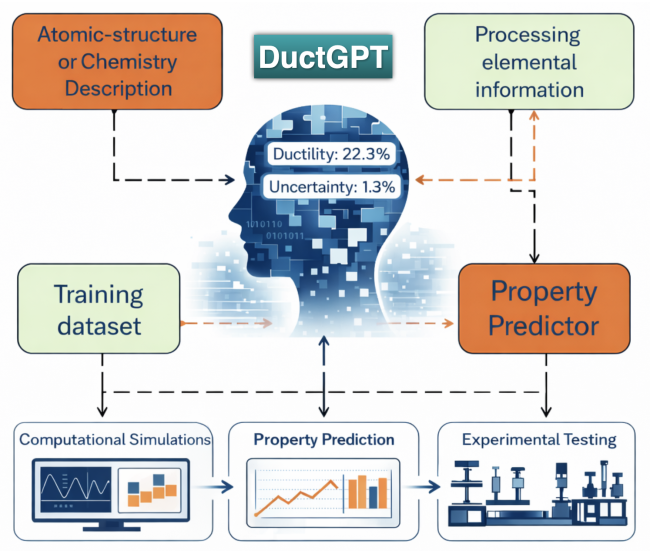
Scientists at Ames National Laboratory developed a new artificial intelligence (AI) tool that accelerates discovery of materials needed for next-generation fusion energy systems. The tool, DuctGPT, combines advanced AI with physics-based modeling to help researchers predict materials with the appropriate properties to function in the extreme conditions inside of fusion reactors. The challenge is to rapidly explore a wide range of potential alloy compositions that can maintain high-temperature strength, while retaining the ductility necessary for manufacturing the materials.
The project, led by Ames Lab Scientist Prashant Singh, was designed to demonstrate how physics-based AI tools can accelerate materials discovery for fusion energy systems, particularly for materials capable of handling intense heat, radiation, and mechanical stress.
The team began with an existing AI model called AtomGPT, which was developed by the National Institute of Standards and Technology. They modified and fine-tuned the model with existing material science data.
DuctGPT can search through a very large number of element combinations in seconds. Additionally, researchers can pose their questions and define parameters in conversational text, which is an integral aspect of GPT (generative pre-trained transformer) AI programs.
“Now when you ask it, ‘I want to design a material for fusion that has all x, y, z properties that are critical for use in fusion reactors. Tell me the combination of elements which satisfy the criteria,’ it will give you those combinations of elements with properties,” said Singh.
Tungsten is a material of specific interest. It is considered one of the best materials for withstanding very high heat, such as the heat generated during nuclear fusion. It also has a relatively short cooling period and remains radioactive for the shortest amount of time after being exposed to nuclear fusion. Unfortunately, it also has a major drawback.
“Tungsten’s main limitation is its lack of low-temperature tensile ductility, which makes it difficult to form into complex shapes,” said Singh. “With DuctGPT, we can now query compositions within a desired space, such as tungsten-titanium-zirconium-hafnium, to identify alloys that maintain tungsten’s strength and high melting temperature while improving ductility.”
Material queries can be performed on a normal desktop computer, rather than needing costly supercomputer calculations. As a result, DuctGPT can reduce discovery time from months to days or hours.
“Ames Lab has demonstrated that ductile refractory alloys can be predictively designed,” Singh said. “We have unique capabilities to synthesize and test the predicted materials, confirming that they truly exhibit the competing properties required for fusion applications.”
The team is expanding the platform to better predict how materials behave during operation by integrating new data and models. This effort, supported by the ARPA-E CHADWICK program and laboratory investments, aligns with the broader goals of the DOE’s Genesis mission to accelerate the discovery and deployment of advanced materials for future energy technologies.
This research is further discussed in: “DuctGPT: A Generative Transformer for Forward Screening of Ductile Refractory Multi-Principal Element Alloys,” written by Sai Pranav Reddy Guduru, Mkpe O. Kekung, Ryan T. Ott, Sougata Roy, and Prashant Singh, and published in Acta Materialia.
Ames National Laboratory is a U.S. Department of Energy Office of Science National Laboratory operated by Iowa State University. Ames Laboratory creates innovative materials, technologies, and energy solutions. We use our expertise, unique capabilities, and interdisciplinary collaborations to solve global problems.
Ames Laboratory is supported by the Office of Science of the U.S. Department of Energy. The Office of Science is the single largest supporter of basic research in the physical sciences in the United States and is working to address some of the most pressing challenges of our time. For more information, please visit https://energy.gov/science.