
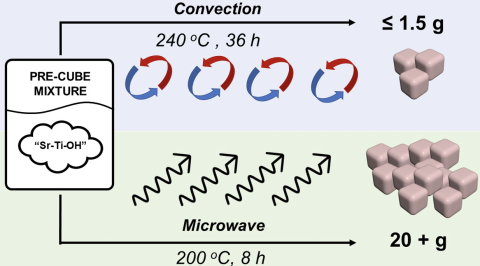
 Scientific Achievement
A microwave-assisted heating method was developed to afford 20+ g STO samples at milder conditions than previously attainable without TiCl4 and in only water.
Significance and Impact
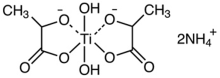
To improve upon catalytic processes, which are promising solutions to addressing the single-use plastic waste crisis, tunable and scalable catalyst synthesis methods are needed. This work highlights a scaled-up STO synthesis with titanium (IV) bisammonium lactato dihydroxide (TiBALD), a water-stable Ti4+ source that replaces TiCl4 and eliminates issues associated with reactor corrosion, reagent stability, and process emissions.
Research Details
- Microwave-assisted hydrothermal techniques were used to synthesize STO nanocuboids on a 20+ g scale with and without TiCl4
- STO nanocuboids were determined to form in a two-step precipitation and growth process based on investigations of pre-hydrothermal Sr-Ti-OH reaction mixtures
I.L. Peczak, R.M. Kennedy, A.M. Simpson, M. Delferro, K.R. Poeppelmeier. “Microwave-Assisted Synthesis of SrTiO3 Nanocuboids without TiCl4”. Small Science, 2023, 2200107, https://doi.org/10.1002/smsc.202200107.
Supported by the Institute for Cooperative Upcycling of Plastics (iCOUP), an Energy Frontier Research Center funded by the U.S. Department of Energy, Office of Science, Basic Energy Sciences under contracts DE-AC-02-06CH11357 and DE-AC-02-07CH11358.