
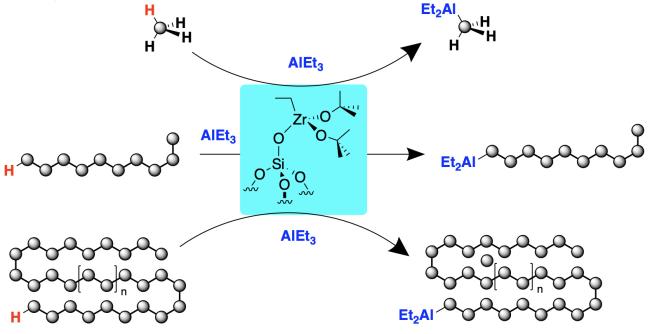
Scientific Achievement
Saturated hydrocarbons are catalytically and selectively transformed into organoaluminum intermediates via zirconium-mediated terminal C–H bond cleavage and C–Al bond formation, as a new functionalization method that complements oxidation, borylation, and silylation.
Significance and Impact
The first hydrocarbon alumination converts methane, base oils, paraffins, or polyolefins into alkyl-aluminums. The air-stable Zr pre-catalyst and AlEt3 reagent are inexpensive and commercially available, and this one-step alumination could replace conventional, energy-intensive syntheses of commodities.
Research Details
- Silica/alumina-supported ≡SiO–Zr(OtBu)3 reacts with AlEt3 to generate the active catalyst in situ.
- Catalytic alkylaluminum products are reacted with O2 to generate alcohols, and analyzed by NMR, GC, and MALDI-TOF-MS
Kanbur et al. J. Am. Chem. Soc. 2023, 145, 2901-2910. https://doi.org/10.1021/jacs.2c11056
Perras et al. Inorg. Chem. 2022, 61, 1067-1078. https://doi.org/10.1021/acs.inorgchem.1c03200