
Scientific Achievement
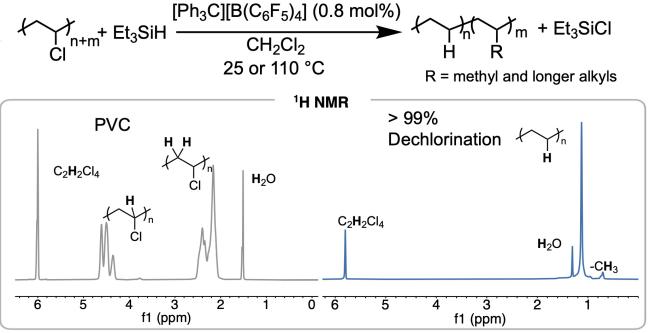
Poly(vinyl chloride) was fully dechlorinated, in a reaction mediated by silylium ions under air, to give branched polyethylene products.
Significance and Impact
PVC is the third most produced plastic, yet <1% is recycled in the US and its presence in mixed plastics limits all plastic recycling. Selective dechlorination of PVC is needed to enable utilization of polymer waste.
Research Details
- The Et3Si+ active catalyst is generated in situ, in air, using benchtop reagents
- Detailed characterization on final products (NMR, TGA, DSC, FT-IR, SEC)
- Post-consumer materials, such as PVC pipe, used vinyl records, and PVC toys, are fully dechlorinated by this method
Wood, Z. A.; Castro, E.; Nguyen, A. N.; Fieser, M. E. Conversion of waste poly(vinyl chloride) to branched polyethylene mediated by siylium ions. Chem. Sci., 2024, 15, 8766. https://doi.org/10.1039/D4SC00130C
iCOUP, an EFRC Supported by Basic Energy Sciences
Work was performed at University of Southern California