
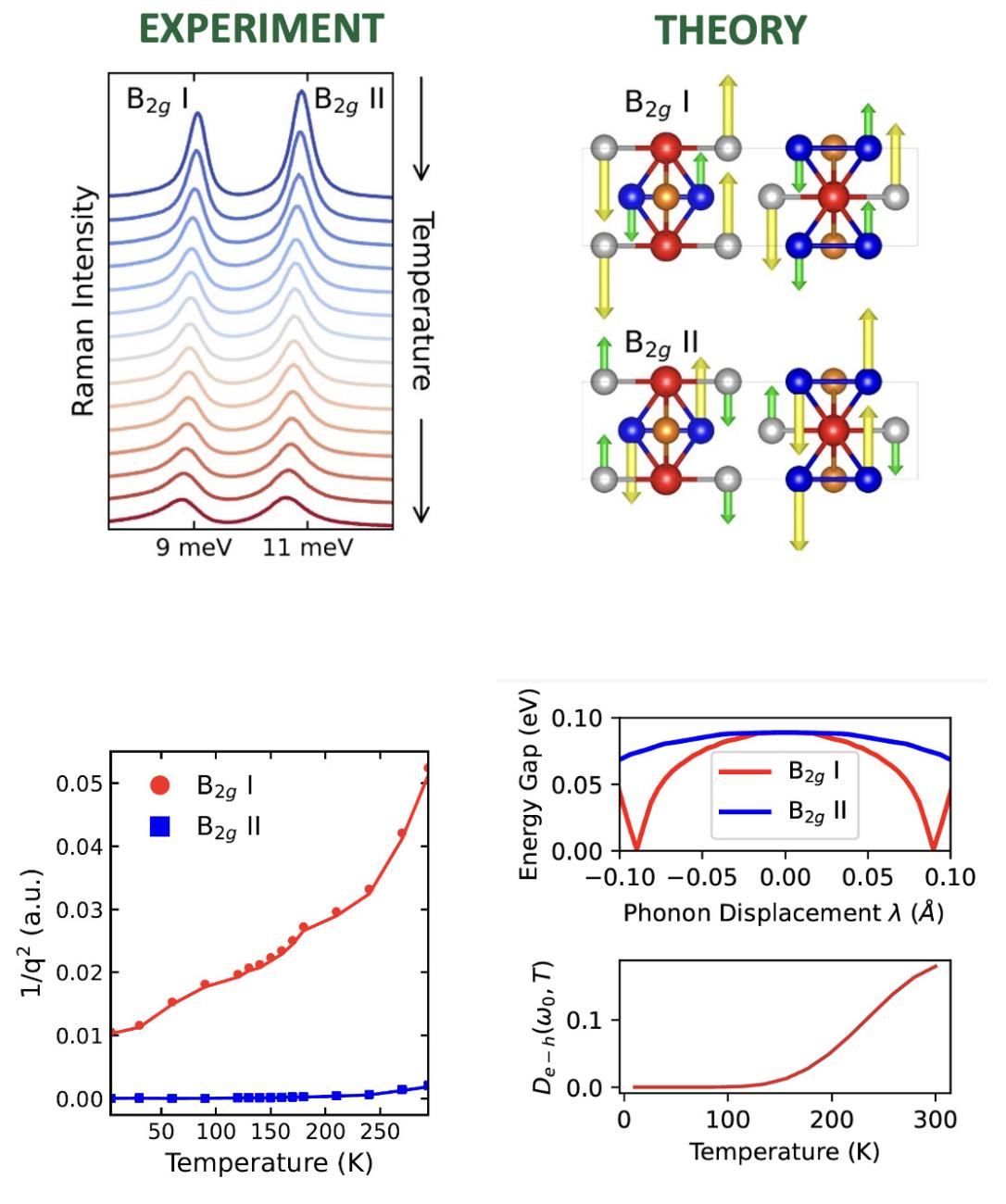
Bottom left: Fano parameter (1/q2) grows with temperature for B2g I mode, while it remains close to zero for B2g II. Bottom right: Phonon-induced energy gap modulation is much stronger for B2g I. The temperature-induced increase in the joint electron–hole density of states enhances the Fano resonance.
Scientific Achievement
Terahertz Raman scattering experiments reveal a Fano resonance in ZrTe₅, characterized by Raman mode selectivity and temperature-dependent enhancement. This behavior is explained by mode-selective electron–phonon coupling and temperature-induced band structure renormalization, through first-principles calculations and model analysis.
Significance and Impact
This establishes terahertz Raman scattering as a sensitive probe of low-energy electron–phonon interactions in topological materials. The findings provide a pathway to engineer and control materials properties via phonon-selective coupling.
Research Details
- Two adjacent B2g Raman modes were identified in ZrTe₅ experimentally, with only B2g I mode exhibiting an asymmetric Fano lineshape.
- The Fano parameter (1/q2) is found to increase at elevated temperatures.
- First-principles calculations reveal a stronger electron-phonon coupling for B2g I mode, evidenced by a significantly larger band gap modulation with phonon amplitude.
- The thermal enhancement of the Fano resonance is attributed to the increased joint electron-hole density of states at phonon frequency with rising temperature.
Supported by U.S. Department of Energy, Office of Basic Energy Science, Division of Materials Sciences and Engineering.
D. Cheng†, T. Jiang†, F. Zhang , G. Gu, L. Luo , C.K. Huang, B.Q Song, M. Mootz , A. Khatri, J.M. Park, Q. Li, Y-X. Yao, and J. Wang*, Phys Rev B (Editors' Suggestion), 112, 075108 (2025). DOI: 10.1103/zj2h-zt13