
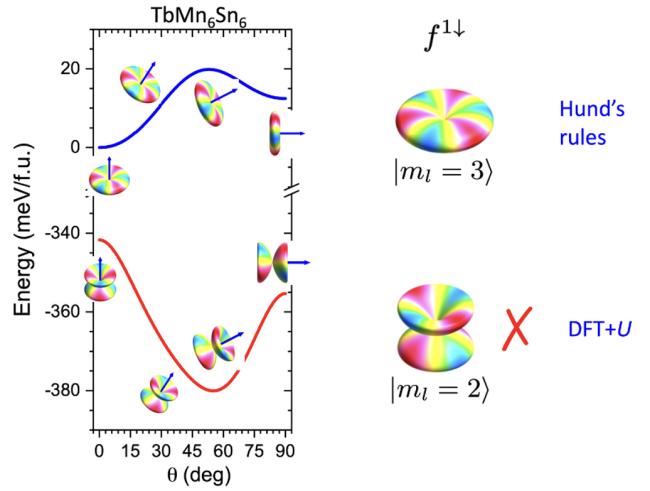
4f charge asphericity and MA of different Tb3+ states in TbMn6Sn6. Standard DFT+U calculations yield the wrong 4f ground state, translating into wrong MA, unless Hund’s rules are explicitly enforced.
Scientific Achievement
Enforcing Hund’s rules in density functional theory (DFT) calculations is necessary for reliable modeling of rare-earth magnetic anisotropy (MA). Scientists at Ames National Laboratory and George Mason University collaborated to identify and address the most fundamental challenge in accurately modeling rare-earth MA within DFT.
Significance and Impact
This finding necessitates revising standard methods for modeling rare-earth MA within DFT. Our proposed approach enables efficient and accurate modeling, essential for designing and developing advanced materials containing critical rare-earth elements.
Research Details
- DFT methods yield incorrect 4f ground states and MA, due to self-interaction errors and inadequate orbital polarization.
- Benchmarking many compounds shows that enforcing Hund’s rules, typically via constrained DFT, ensures accurate MA modeling.
- Additionally, we introduce an efficient perturbation approach using Gd crystal field levels from corresponding compounds for rapid MA modeling.
Supported by the Office of Basic Energy Sciences, Clean Energy and Manufacturing program, and Early Career Research program.
Y. Lee, Z. Ning, R. Flint, R.J. McQueeney, I.I. Mazin, Liqin Ke*, npj Comput Mater 2025 11, 168. DOI: 10.1038/s41524-025-01632-3