
Scientific Achievement
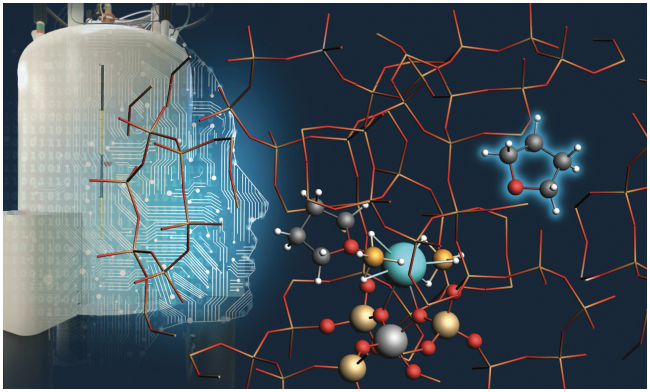
Catalytically active La-complex grafted on zeolite was structurally identified using solid-state (SS)NMR and machine-learning molecular dynamics (ML-MD) simulations.
Significance and Impact
The study establishes the structural origin of C-H borylation activity in zeolite-supported La complexes. The combined SSNMR and ML-MD approach offers a general framework for identifying catalytically relevant structures.
Research Details
- SSNMR and DFT calculations identified La species grafted to Brønsted acid sites in a bidentate coordination as active C–H borylation catalyst precursors.
- ML-MD simulations revealed transient THF dissociation, generating low-coordinate La states proposed to contribute to catalytic activity.
Cui, J.; Li, Y.; Liu, D.-J.; Mais, M.; Zhang, J.: Qi, L.: Sadow, A.D.; Kobayashi, T. Inorg. Chem. Front. 2026. DOI: https://doi.org/10.1039/D5QI02586A
This research was supported by the DOE, Office of Science, Office of Basic Energy Sciences, Chemical Sciences, Geosciences, and Biosciences Division, Catalysis Science program. MD simulations were supported under the Computational and Theoretical program. Ames National Laboratory is operated for DOE by Iowa State University under Contract No. DEAC02-07CH11358.