
Scientific Achievement
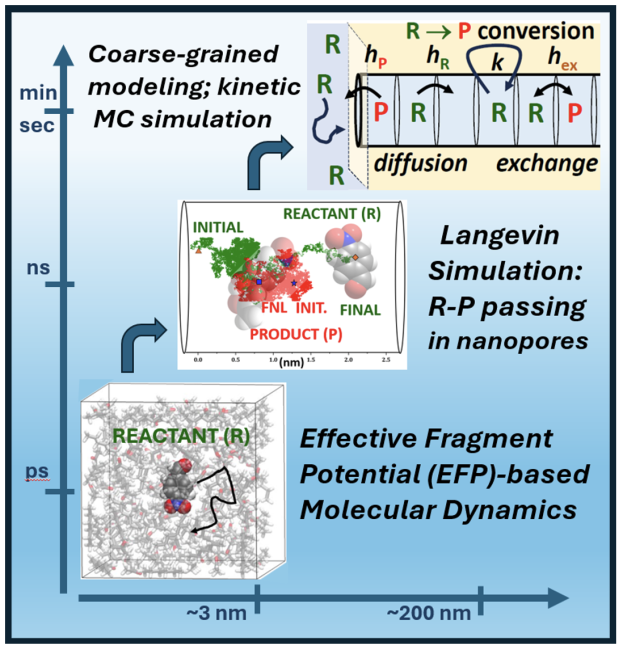
A multiscale modeling framework is developed for catalytic conversion in narrow linear nanopores connecting high-fidelity molecular dynamics (MD), Langevin simulation of rare passing processes & coarse-grained (CG) stochastic modeling on experimental time- and length scales. Anomalous pore diameter dependence of yield is successfully predicted.
Significance and Impact
Nano- or mesoporous materials play a central role in heterogeneous catalysis. However, inhibited transport in narrow pores can lead to a failure of traditional formulations for chemical kinetics. Our multiscale modeling framework enables reliable prediction, interpretation, and elucidation of reaction-diffusion kinetics.
Research Details
- The components of our multiscale treatment (MD, Langevin, CG), and the key hand-shake connections between them, are crafted for our specific application.
- EFP is utilized for high-fidelity MD treatment of the system of interest. Langevin simulation algorithms are crafted to efficiently assess rare reactant-product passing.
- Described conversion of p-nitrobenzaldehyde to aldol product in mesoporous silica.
- Model analysis emphasizes the under appreciated importance of the propensity for reactant-product passing for narrow nanopores in controlling reaction yield.
Kim, Y. L.; Han, Y.; Xu, P.; Rahman, Md. K.; Gordon, M. S.; Evans, J. W., J. Comp. Theoretical Chem. 2026, 22. DOI: 10.1021/acs.jctc.5c01748
This work was supported by the U. S. Department of Energy, Office of Science, Basic Energy Sciences, Computational and Theoretical Chemistry program.