
 Scientific Achievement
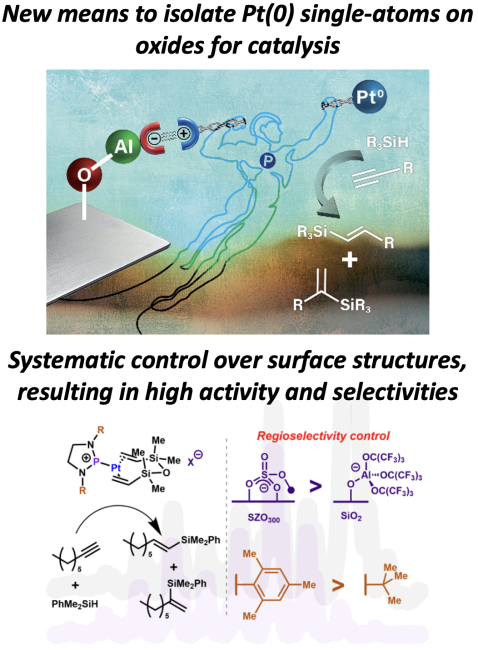
Only a small fraction of metals in most industrial catalysts are active, inefficiently utilizing critical materials. We developed a simple and cost‑effective strategy to anchor isolated platinum atoms onto hybrid organic-inorganic surfaces with molecular‑level precision.
Significance and Impact
This strategy enables systematic studies of structure-activity relationships and supports the design of catalysts that use less critical materials while achieving selectivity beyond that of conventional heterogeneous catalysts.
Research Details
- Oxides functionalized with phosphenium ions coordinate to Pt(0) forming well-defined, electrostatically-bound complexes that are highly-active heterogeneous alkyne hydrosilylation catalysts.
- Solid-state 31P NMR shows that we can rationally control the structure of the surface-bound catalysts.
- Bulky, aromatic phosphenium ligands support Pt catalysts that are as regioselective as molecular catalysts.
Culver, D. B.;* Mais, M.; Kang, M. C.; Zhou, L.; Perras, F. A. Dalton Trans. 2025, 54, 8392-8399. https://doi.org/10.1039/D5DT00680E
Culver, D. B.;* Neill, C.; Perras, F. A.; Halder, M.; Chartouni, A. Inorg. Chem. 2026, ASAP. https://doi.org/10.1021/acs.inorgchem.5c05042