
 Scientific Achievement
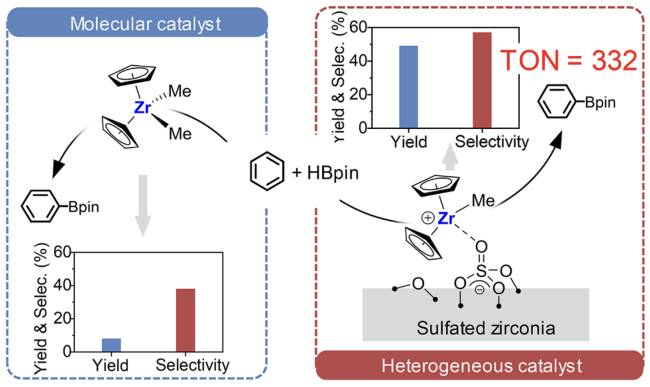
We demonstrated the first use of earth‑abundant group 4 metals for arene C–H borylation by grafting metallocenes onto acidic sulfated zirconia, creating highly active heterogeneous catalysts.
Significance and Impact
This discovery proves that early transition metals can effectively perform challenging C-H bond functionalization, rivaling established, expensive late-transition metal (Ir, Rh) systems. It opens new paths and design principles for strong-bond activation using highly electrophilic, surface-stabilized active sites in alterative to critical noble metals.
Research Details
- The Zr-based catalyst outperforms Ti and Hf analogs, delivering 332 turnovers and up to 82% chemoselectivity at high HBpin conversion.
- The strong Brønsted acid sites of the sulfated zirconium oxide support are critical; they facilitate the formation of low-coordinate, cationic active sites that vastly outperform neutral silica-supported or molecular analogs.
- Kinetic analysis indicates C–H bond activation is rate-limiting, providing a foundation for future mechanistic and catalyst design studies.
Zhang, J.;§ Halder, H.;§ Li, Y.;§ Riestra, A.; Kobayashi, T.; Mais, M.; Mayer, J.; Perras, F. A.; Culver, D. B.;* Qi, L*, J. Am. Chem. Soc. 2026, ASAP. DOI: https://doi.org/10.1021/jacs.6c01025
§Equal contributions.